
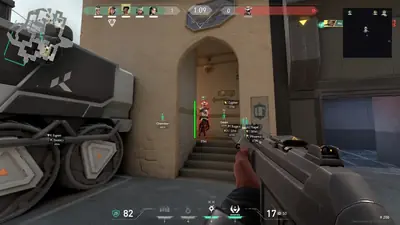
Valorant ESP: Reading Utility Not Just Bodies
Boxes on enemies is the easy part. The Valorant ESP layer that actually changes rounds is the utility and spike tracking and it needs different settings.
Every Valorant cheat page leads with enemy boxes because that is what people search for. It is also the least interesting layer in the game. Seeing an enemy is a problem your ears solve most of the time. Seeing a tripwire you were about to walk into is a problem your ears cannot solve at all.
The build has both. This is about the second one. The full build lists every module. Aimbot tuning is a separate article.
The player layer briefly
Health bar shield bar agent rank level equipment name distance box snapline view direction skeleton head circle max distance.
Agent and equipment name are worth keeping. Knowing the enemy is a Jett with an Operator before you swing is a different decision than a Sage with a shotgun. Rank tells you how much respect the player behind the crosshair deserves in the first thirty seconds.
Boxes and head circles together is fine. Skeletons are better in a stack and worse in a long lane. Snaplines are useful for a week and then become noise.
The utility layer which is the point
Ability and trap markers per character with full coverage of every agent kit.
- Sentinel setups. Cypher trips cages and spycam. Killjoy turret alarmbot and nanoswarm. Vyse arc rose shear and razorvine. Sage wall. Deadlock sonic sensor and mesh.
- Recon. Sova dart Fade haunt and prowler Skye bird. Knowing a recon is inbound tells you to break line before it lands.
- Smokes and walls. Omen Brimstone Astra and Harbor utility marked means you know which angle is blind.
- Mobility. Jett dash Raze satchel Neon sprint. Less about the marker and more about knowing what is available to the player holding that angle.
Patch 13.10 shortened sentinel cooldowns so traps come back sooner than they did a week ago. That makes this layer more valuable this act than last.
Spike tracking
Defuse progress and remaining time through walls. This is the single most useful line in the overlay. Defuse progress tells you whether you can win by time or whether you have to take the fight. The timer tells you how many seconds of the round are actually left.
Combat mode and filtering
The utility layer is valuable before a fight and cluttering during one. There is a combat mode hotkey that hides ability and trap ESP the moment you engage and puts it back when you disengage. Bind it somewhere your hand already sits.
Enemy only. Always. Max distance at 60 to 80 metres in competitive. Valorant lanes are short. Visible check on. Off you rotate toward players who have not seen you and you walk into the one angle they are holding. Drop snaplines and skeletons once you know the map. Keep boxes health shield and equipment.
A working config
Competitive: enemy only box health shield agent equipment distance visible check 70 metre cap utility and spike on combat mode bound. Deathmatch: enemy only box health distance no cap utility off combat mode bound. Save both. Load one. If you stream stream proof keeps the overlay off capture. Cloud DMA is the delivery layer for the stack.